
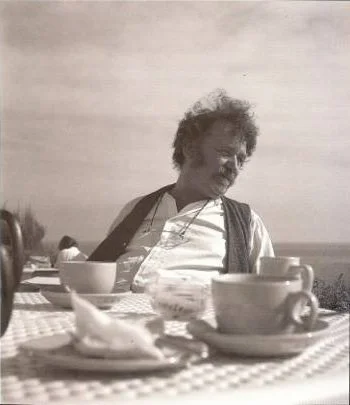
Bryan Ingham (British, 1936–1997)
Born in Preston, Lancashire, in 1936, Bryan Ingham's work is a testament to his exceptional skill and deep understanding of 20th-century art history. His artistic training at St Martin’s School of Art, the Royal College of Art, and the British Academy in Rome provided the foundation for a career that would play a pivotal role in the narrative of British art.
Ingham’s career took a distinctive turn after his studies in London and Rome during the 1950s and '60s. Rather than joining the buzzing art scene of London, where artists like David Hockney, Bridget Riley, and Peter Blake were defining the era’s ‘cool’ aesthetic, Ingham chose a more solitary path. He moved to a remote house in Jollytown, Cornwall, immersing himself in the rural surroundings that would shape much of his work. Following in the footsteps of earlier artists such as Ben Nicholson and Barbara Hepworth, who had similarly left London for St Ives, Ingham drew inspiration from the rugged landscapes of Cornwall—the rough rocks, ancient surfaces, and undulating hillsides—that would become central motifs in his art through the 1970s, '80s, and '90s.
Ingham was attuned to the rich artistic heritage of Britain and sought inspiration from the greats, including Ben Nicholson, Picasso, Braque, and Mondrian. However, his style was uniquely his own, enriched by the influence of lesser-known figures such as Peter Lanyon and Wilhelmina Barns-Graham, whose interpretations of landscape also deeply resonated with him. As art critic William Parker noted in his introduction to Ingham’s 2006 exhibition: “His true achievement was to absorb it all with a cool, visual intelligence.”
Ingham's work often revolved around recurring themes, explored across different mediums throughout his career. This is evident in the Mediterranean Heads series, which he began in the late 1980s and continued into the 1990s. Ingham was an artist who refused to conform to trends or the pressures of the London art scene. Instead, he carved out his own unique artistic journey, constantly evolving and finding new ways to express his vision.