
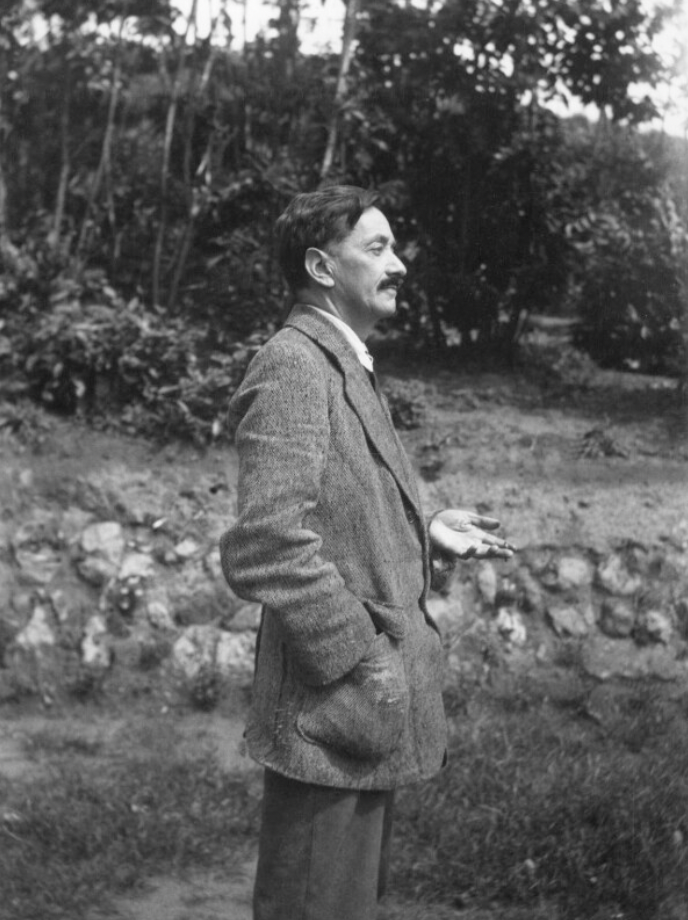
Photo of Simon Bussy, courtesy of the National Portrait Gallery, London
Simon Bussy (French / British, 1870 – 1954)
Simon Bussy (French/British, 1870–1954) was a distinguished painter and draughtsman whose work bridged the artistic traditions of France and Britain during the first half of the twentieth century. Born in Dole, France, he studied at the École des Beaux-Arts in Paris under Gustave Moreau, whose atelier also nurtured artists such as Henri Matisse, Georges Rouault and Albert Marquet. During this formative period, Bussy absorbed the progressive ideas emerging in Paris while developing a distinctive artistic language founded upon precise observation, refined draughtsmanship and a profound appreciation of the natural world.
In the early 1900s, Bussy settled in England after marrying the English writer Dorothy Strachey, becoming closely associated with the Bloomsbury Group and the wider circle of influential intellectuals that included Lytton Strachey, Virginia Woolf and André Gide. Although he remained somewhat independent of any single artistic movement, his work reflects a sophisticated synthesis of French Symbolism, Post-Impressionism and British decorative traditions.
Bussy is best remembered for his exquisitely observed portraits of animals and birds, subjects through which he achieved a remarkable balance of scientific accuracy and poetic expression. Working in oil, pastel and pencil, he captured the individuality and vitality of exotic and domestic species with exceptional sensitivity, establishing himself as one of the finest animal painters of his generation. His works were widely exhibited in Britain and France and are represented in major public collections, including the British Museum, Tate, the Fitzwilliam Museum and the National Portrait Gallery.
Beyond his technical accomplishments, Bussy made an important contribution to twentieth-century art by elevating animal portraiture beyond straightforward natural history illustration into a form of modern artistic expression. His drawings and paintings combine elegant design with acute observation, demonstrating that studies of the natural world could possess the same psychological depth and aesthetic sophistication as portraiture. Today his work continues to be admired for its quiet refinement, masterful draughtsmanship and enduring celebration of the beauty and character of the living world.